

Vegetable Oil Consumption Can Increase Heart Disease Risk
Back in the 20th century, Ancel Keys delivered a message to the American public: We’ve become an indulgent nation and we consume too many saturated fats which causes cholesterol levels to rise and this is driving high rates of heart disease. This is what is known as the “lipid hypothesis” or the “diet-heart hypothesis.” Ancil told us what the solution was:
Stop eating saturated fats from things like butter, whole milk, full-fat cheese, etc. and eat more polyunsaturated fats from sources such as refined vegetable oils and margarines that contain omega-6 fatty acids like linoleic acid. This will decrease cholesterol and result in fewer heart attacks.
 Various sources of dietary fats. Image Credit: Getty Images
This message was taken up and implemented as food policy in the United States, notably by the United States Department of Agriculture who publishes the “Food Guide Pyramid” (now called MyPlate). Anyone familiar with history is aware of how this turned out. It resulted in Americans drastically increasing their consumption of trans fats and processed oils. This policy (along with the low-fat guidelines which caused Americans to drastically increase their sugar consumption) decimated the health of millions of Americans. Heart disease, diabetes, cancer, metabolic syndrome, obesity, asthma, and other diseases gained a strong foothold.
It took decades, but eventually we came to our senses, at least partially. We turned our back on trans fats and outlawed them from the food supply. This was a good step in the right direction, but it didn’t go far enough.
The food industry and Ancel Keys’ sympathizers doubled down. They said the problem is still saturated fats. The solution: eat less saturated fat and eat more polyunsaturated fats from things like vegetable oils and margarines. Butter, cheese and egg yolks were out and soybean oil, corn oil and vegetable spreads were in.
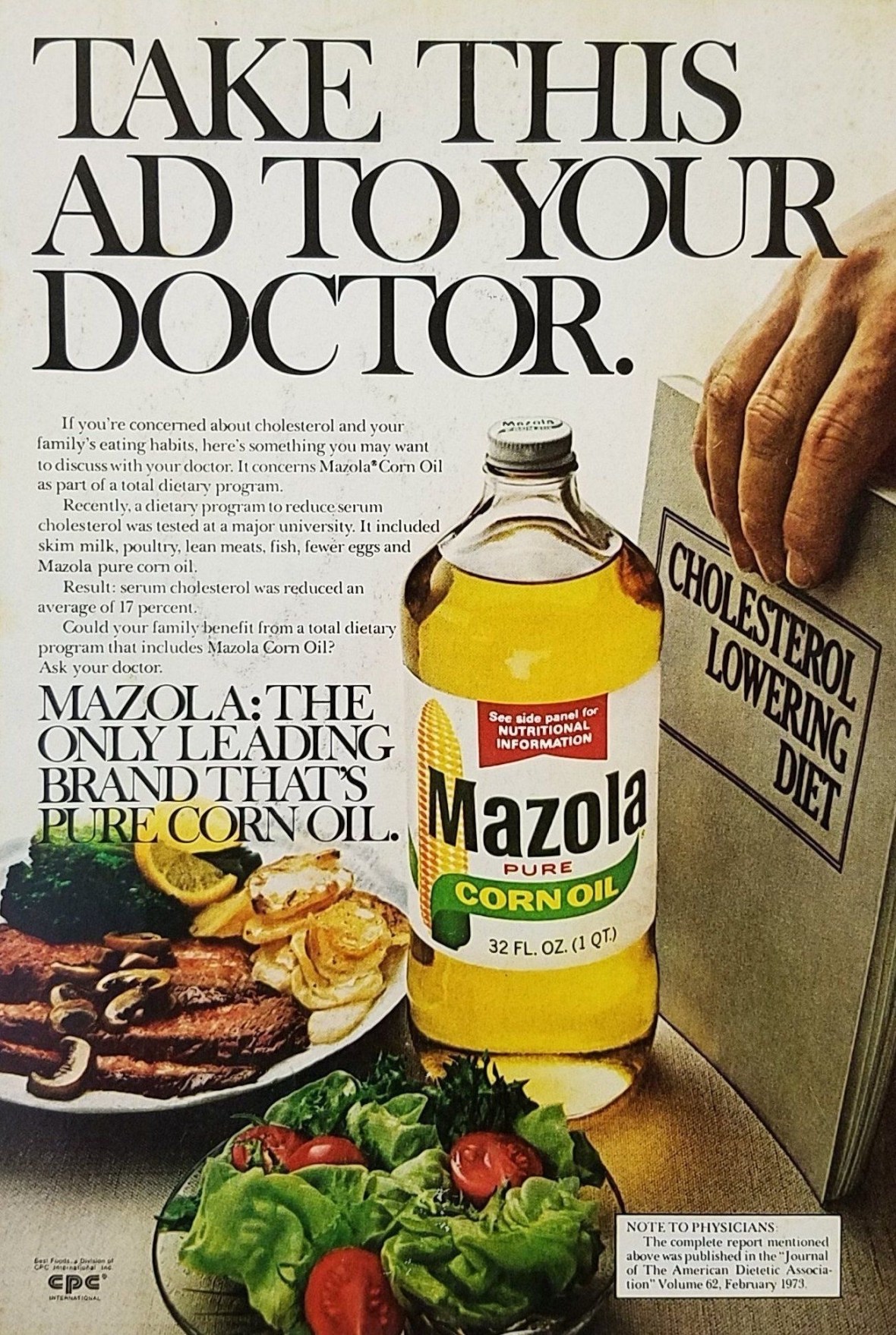 An old corn oil advertisement
Not everyone was convinced. There was a crowd of scientists that questioned these policies and proposed that it was actually the refined, processed fats and oils that were the problem. Their cries fell on deaf ears for the most part. I’d be remiss if I didn’t mention the nutritionist, Mary Enig.
The pro-vegetable oil crowd did actually have a shred of evidence they could stand on, as long as they viewed the data from the standpoint of the lipid hypothesis being accurate. Omega-6 polyunsaturated fats like those found in soybean oil could be shown to lower cholesterol levels in food studies. According to the lipid hypothesis, if you lower cholesterol you lower heart disease risk. It seems inuitive, but this was an unproven hypothesis when they proposed the theory and it has remained unproven to this day. Half of the major heart attacks occur in people who have normal cholesterol levels.
Over time, we found out that cholesterol levels don’t tell the whole story. Things such as oxidized-LDL cholesterol, LDL particle size counts, chronic inflammation, improper calcium utilization in the body, infections, stress levels, lifestyle choices, and more also play important roles in heart disease risk and cannot be ignored.
After decades of research, the truth of the matter is finally starting to come to light. A study published in the British Medical Journal does a great job of summarizing some of the findings.
Omega-6 vegetable oils as a driver of coronary heart disease: the oxidized linoleic acid hypothesis
“The intake of omega-6 vegetable oils, particularly soybean oil, began to increase in the USA starting in the early 1900s at a time when the consumption of butter and lard was on the decline. This caused a more than two-fold increase in the intake of linoleic acid, the main omega-6 polyunsaturated fat found in vegetable oils, which now makes up around 8% to 10% of total energy intake in the Western world. The omega-6 fat linoleic acid should not be confused with conjugated linoleic acid found in pastured animal foods.
A systematic review of studies measuring the changes in linoleic acid concentration in subcutaneous adipose tissue in the USA revealed an approximate 2.5-fold increase in linoleic acid increasing from 9.1% to 21.5% from 1959 to 2008. Importantly, the concentration of linoleic acid in adipose tissue is a reliable marker of intake as the half-life of linoleic acid is approximately 2 years in adipose tissue. The authors of the study also noted that the increase in adipose tissue linoleic paralleled the increase in the prevalence of diabetes, obesity and asthma.”
Summary
“The consumption of the omega-6 polyunsaturated fat linoleic acid has dramatically increased in the western world primarily in the form of vegetable oils. [Oxidized LDL (OxLDL)] is thought to play an important role in atherosclerosis formation; however, it is the oxidised linoleic acid contained in LDL that leads to harmful OXLAMs, which induces atherosclerosis and [coronary heart disease (CHD)]. Thus, reducing the amount of dietary linoleic acid, mainly from industrial vegetable/seed oils, will reduce the amount of linoleic acid in LDL and likely reduce oxLDL as well as the risk for coronary heart disease.
In summary, numerous lines of evidence show that the omega-6 polyunsaturated fat linoleic acid promotes oxidative stress, oxidised LDL, chronic low-grade inflammation and atherosclerosis, and is likely a major dietary culprit for causing [coronary heart disease (CHD)], especially when consumed in the form of industrial seed oils commonly referred to as ‘vegetable oils’.”
Note: This article should not be generalized to mean omega-6 fats, linoleic acid or polyunsaturated fats are bad for you in general. The take-away is that we eat too much of them to the point where they create inflammatory conditions inside the body AND that we often consume them from the wrong sources (e.g. processed, refined oils).
What Does the World Need More Of?
A friend of mine recently shared this with me. He wanted to ask the question “What does the world need more of?” After a Google search, he found this answer on the Quora website: Link

The author goes on:
“We need bass players on construction sites, nail guns firing in tempo.
Just imagine that for a second. A house is going up. The workers are using their tools as percussion instruments, keeping time, adding their own beats —individual rhythms, but in cohesion. And then…a walking bass line starts up…a piccolo or tin whistle cuts in, beginning the melody of the day… (what else would carry over the cacophony of a construction site?) No, they’re not playing anything you’ve ever heard before. There is no composer, no author, nor recording they’re trying to emulate. It will only be played once. In this moment…can you hear it? Would you want to be part of that crew or a member of their ‘audience’?”
…there’s too many households without music… Without music, everything becomes discordant chaos.
So here’s your reminder you make some music today: sing a song, look dumb dancing in your kitchen, or simply turn off the TV and put some of your favorite music on.
Why Isn’t Digital Audio Perfect?
Digital glare. A plague of digital audio playback systems. It seems the best comment a CD player or digital source can get is to sound “like analog” or “as good as vinyl.” I’ve gone to great lengths to battle this in my CD-based 2-channel system but it’s never ending. My father, upon hearing my system for the first time (and at loud volumes), said this: “The treble isn’t offensive to my ears.” What a great compliment! My hard work has paid off, but the “glare” isn’t completely gone… yet.
Digital glare can manifest in multiple ways, often in the form of piercing high frequencies or “shouty” midrange frequencies. A hallmark signature is that long listening sessions, especially at louder volumes, leads to listener fatigue: your ears may hurt or you may get a slight headache that makes you want to turn the music off. Analog sources, like vinyl records or reel-to-reel tapes, don’t seem to be as plagued by this as digital sources are.
So what does digital do wrong? Is it a problem with the format or the playback hardware? Why does it take so much work to make digital sound as good or better than analog recordings? The technical specs tell us digital is far superior to vinyl or reel to reel. Does it try too hard? Where digital is trying to capture the micro details of complex passages, analog just “rounds it off” and says “good enough,” and it sounds good enough? Or does digital have some other issue in the chain – noise in the DAC chip, high frequency harmonics, or issues with the anti-aliasing filter? Does it have to do with the power supply? If you ask any audiophile, they’ll tell you that clean power is very important.
There are studies that show people subjectively prefer the sound of vinyl, even if only by a small margin. That doesn’t quite add up when we consider digital’s dominant technical specifications. On paper, digital should win.
So what’s really going on here? Why doesn’t digital knock the socks off vinyl and why does there appear to be some issue with “digital glare” in these types of audio systems that takes some serious work to resolve?

A flow of audio from sound waves through a microphone to an analog voltage, A-D converter, computer, D-A converter, analog voltage, speaker and finally as sound waves again. Image Credit: Wikipedia User: Teeks99
Using Drones to Plant 500 Billion Trees
A UK company, Dendra Systems, is working towards planting 500 billion trees by 2060 by dropping seeds via airborne drones. Since the drones can selectively plant, the researchers can deliberately create ecosystems of trees that are right for the environment and local land features, and can also get to hard-to-reach places.
“The WWF estimates we’re losing 27 football fields of forest every minute due to deforestation.
A drone can plant two trees per second, according to UK tech company Dendra, which is aiming to “re-green” the planet.
Dendra estimates it would take just 400 teams of two drone operators, with 10 drones per team, to plant 10 billion trees each year – and at a much lower cost than the traditional method of planting by hand.
The target is to plant 500 billion trees by 2060, in often hard-to-reach places.
Susan Graham, CEO of Dendra Systems, says, “The challenge that we’re tackling is a complex one and working with a team of passionate engineers, plant scientists, drone operators, we came up with this idea to use automation and digital intelligence to plant billions of trees.””
To read more, click here: Link
To see a minute long video, click here: Link

 Upside Up Life